
How AI and LLMs are Transforming Accreditation
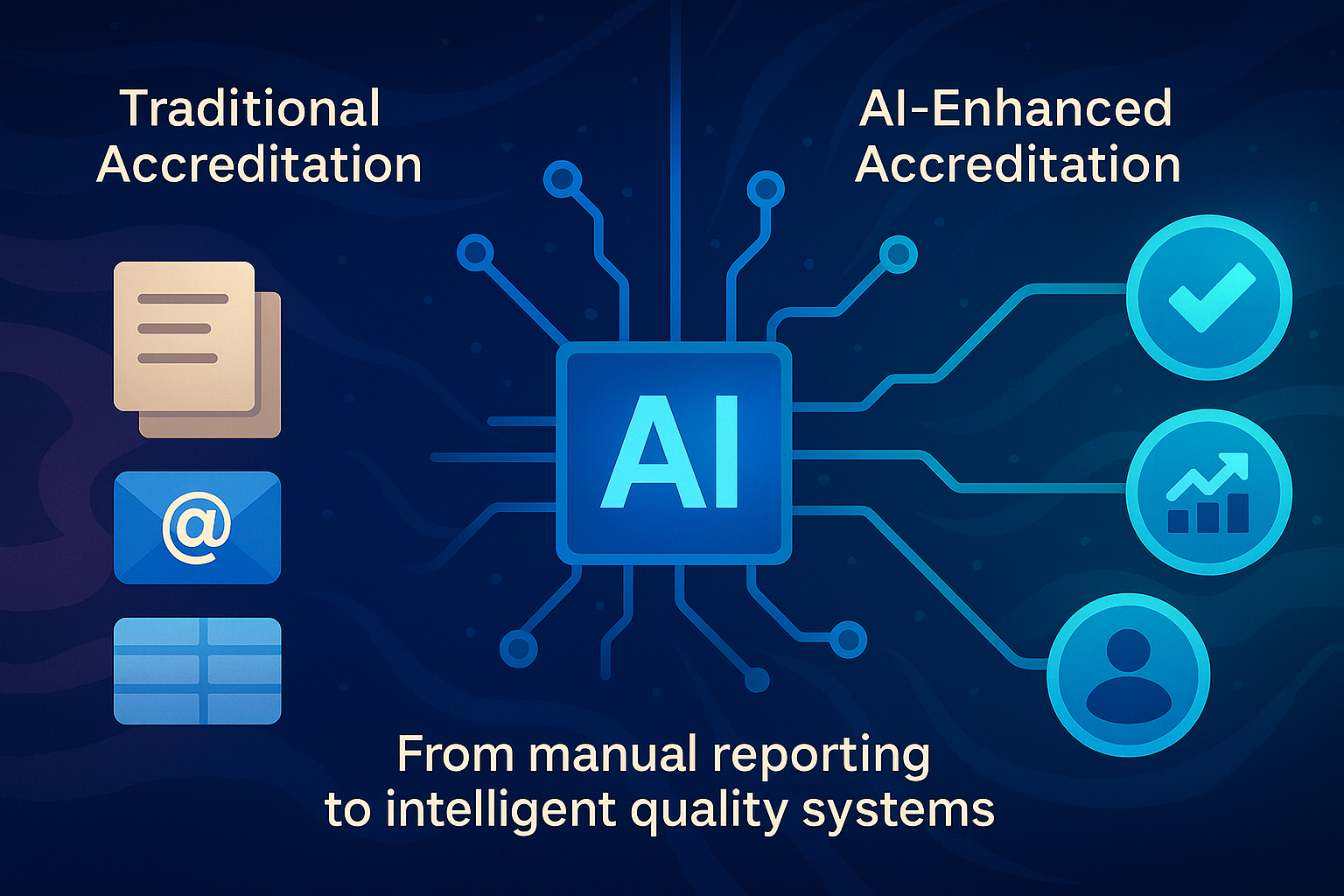
The management of institutional accreditation and effectiveness is undergoing a profound transformation, driven by the dual pressures of increasing complexity and the advent of sophisticated digital tools. Traditional accreditation processes, characterized as manual, costly, and resource-intensive, are proving unsustainable for modern institutions. Specialized accreditation software has emerged as a critical solution, offering automation, centralized data management, and real-time compliance monitoring, which can reduce preparation time by over 50% and administrative workload by as much as 70%.
Concurrently, Artificial Intelligence (AI) and Large Language Models (LLMs) are being integrated to further enhance these platforms, enabling advanced data analysis, natural language queries, and automated workflows. However, the enterprise-level deployment of LLMs presents a significant paradigm shift from traditional data infrastructure. It demands specialized computational resources (GPUs/TPUs), novel architectural patterns like Retrieval-Augmented Generation (RAG) to combat inaccuracies, and robust monitoring systems.
Key challenges in enterprise LLM adoption include data privacy, model "hallucinations," security against prompt injection, and escalating costs. All of these must be systematically addressed. The successful integration of these technologies hinges on a strategic approach that balances control, cost, and capability, often through hybrid cloud and on-premises deployment models. As these technologies mature, they are set to become foundational infrastructure, deeply embedded in institutional operations and central to achieving continuous quality improvement and data-informed decision-Making.
1. The Challenge of Traditional Accreditation and Institutional Management
The process of preparing for institutional and programmatic accreditation is a mission-critical yet frequently burdensome undertaking for higher education leadership teams. Sources describe the traditional workflow as a manual, cumbersome process which lacks the necessary infrastructure and Technology to maintain accreditation documents and processes over time. The reliance on disjointed tools such as MS Word, Excel, shared drives, spreadsheets, and emails puts institutions at risk and diverts focus from the quality of the submission to merely meeting deadlines.
The economic and human resource costs are substantial. For example, Vanderbilt University's College of Art and Sciences reportedly spends over 5,000 hours annually, equivalent to approximately $2.92 million, solely on regional accreditor reporting. Without dedicated platforms, institutions face scattered documentation, a high risk of human error, difficulty tracking deadlines, and a reactive rather than proactive approach to compliance.
2. The Rise of Specialized Accreditation Software
To address these systemic inefficiencies, a new category of dedicated accreditation software has become essential for educational institutions, professional certification bodies, and healthcare organizations. These platforms transform complex compliance requirements into streamlined, manageable digital tasks.
Core Capabilities and Features
Accreditation software provides a centralized, intuitive framework that automates and integrates critical institutional processes.
| Feature Category | Core Capabilities | Impact on Institutional Workflow |
|---|---|---|
| Data Management | Centralized digital repository for all documents, automated data collection, version control, and flexible format support (PDF, DOCX, etc.). | Eliminates version confusion, reduces manual data entry errors, and saves significant costs on materials like paper and ink. |
| Compliance Monitoring | Real-time tracking of compliance status, automated alerts for deadlines, gap analysis to identify areas for improvement, and audit trails. | Enables proactive issue resolution, ensures continuous compliance, and prepares institutions for audits. Organizations using such systems achieve an 80% average compliance success rate. |
| Reporting & Analytics | Customizable report generation, interactive dashboards with real-time data visualization (KPIs, compliance rates), and multiple export options (PDF, Excel). | Provides clear, actionable insights from institutional data, automates stakeholder reporting, and facilitates data-informed decision-making. |
| Integration | Seamless connection with existing campus systems like Student Information Systems (SIS) and Learning Management Systems (LMS) via APIs and LTI standards. | Reduces administrative workload by up to 70% by eliminating redundant data entry and creating a unified data ecosystem. |
Implementation Models and ROI
Institutions can choose from several implementation models, each with distinct benefits:
• Cloud-based SaaS: Offers flexibility, automatic updates, and lower upfront costs with minimal IT overhead.
• On-premise: Provides complete control over data and security, ideal for institutions with strict data sovereignty requirements.
• Hybrid: Balances the control of on-premise solutions with the convenience and scalability of the cloud.
The return on investment (ROI) is significant. Institutions report a 50% or more reduction in time spent on self-assessment and onsite preparation. Furthermore, tasks like manual certificate creation can see time savings of 80-90%, while error rates related to data entry become nearly non-existent.
3. The Integration of AI in Higher Education Platforms
Building on the foundation of digital management, companies are actively integrating Artificial Intelligence to further automate and enhance assessment and credentialing products. The strategy focuses on leveraging AI's ability to analyze language and streamline complex workflows.
AI-Powered Data Analysis and Automation
The primary applications of AI are centered on two areas:
1. Analyzing and Summarizing Data: AI is used to extract insights from the large volume of feedback and assessment data institutions collect.
o Trend Identification: AI can analyze unstructured data such as course survey responses to surface common themes and potential concerns.
o Natural Language Queries: Faculty and administrators would be able to ask direct questions of assessment data (e.g., “Show math and English proficiency results over the past five years”).
2. Reducing Manual Work: AI tools are ideal for automating and assisting with some institutional tasks that currently require significant staffing resources.
o Curriculum Mapping: AI could suggest alignments between course content and institutional learning outcomes.
o Accreditation Support: AI could be used for automated tagging of evidence, linking assignments to competencies, and compiling pre-structured self-study reports by mapping evidence to accreditation requirements.
Future Exploration of AI's Role
The long-term vision includes expanding AI's role to streamline broader institutional processes:
• Accreditation Readiness Assistant: An AI tool to monitor compliance, flag missing evidence, and assist with report preparation.
• Smart Workflow Optimization: AI-driven recommendations for improving approval flows and task automation.
• Pattern Recognition: AI could identify data collection gaps across institutional data submissions to inform workflow and process adjustments.
4. The Enterprise LLM Paradigm: A New Infrastructure Challenge
The adoption of Large Language Models (LLMs) in enterprise and institutional settings represents a fundamental technological shift that strains traditional data infrastructure. A recent survey indicates that while 78% of enterprise organizations plan to implement LLM-powered applications by the end of 2025, 65% report significant infrastructure limitations as their primary obstacle.
Limitations of Traditional Infrastructure
Traditional data management systems were not designed for the unique demands of LLMs.
| Challenge | Traditional Infrastructure | LLM Requirement |
|---|---|---|
| Scale & Compute | Processes gigabytes of structured data on CPU clusters. | Requires massive parallel processing on specialized hardware like GPUs and TPUs for models with billions of parameters. |
| Data Type | Focuses on structured data in warehouses with defined schemas. | Primarily consumes unstructured text data, requiring different ETL paradigms and storage solutions like vector databases. |
| Performance | Batch processing is common; real-time is often secondary. | Users expect low-latency, human-like responses, demanding a high-performance, real-time architecture. |
| Data Quality | Concerns include accuracy, completeness, and consistency. | Introduces new concerns like training data bias, token optimization, and semantic drift over time. |
Core Components of LLM-Optimized Infrastructure
Building effective LLM infrastructure requires a purpose-built architecture resting on four pillars:
1. Compute Resources: Specialized hardware like NVIDIA A100 GPUs for training and smaller instances or accelerators for inference.
2. Storage Solutions: Multi-tiered systems including object storage (S3, GCS) for datasets, vector databases (Pinecone, Weaviate, Qdrant) for embeddings, and caching layers (Redis).
3. Networking: High-bandwidth, low-latency connections for distributed training and API gateways for serving endpoints.
4. Data Management: Specialized pipelines for ingesting unstructured text, generating vector embeddings, and tracking data lineage.
Key Architectural Patterns
Two patterns are central to modern LLM implementation:
• Retrieval-Augmented Generation (RAG): This pattern enhances LLMs by connecting them to external or internal knowledge bases via a vector database. It grounds LLM responses in factual source material, solving the critical "hallucination" problem where models generate plausible but incorrect information.
• Hybrid and VPC Deployment: To balance security, cost, and flexibility, many organizations deploy LLMs in a Virtual Private Cloud (VPC) or a hybrid model. This allows sensitive data to remain on-premises or within a secure cloud environment while leveraging the scalability of cloud services. Platforms like TrueFoundry facilitate private hosting of open-source models.
Adopting this specialized approach can lead to a 30–40% lower total cost of ownership and inference latency improvements of 5–10x compared to general-purpose infrastructure.
5. Critical Challenges and Solutions in Enterprise LLM Adoption
Deploying LLMs in a production environment introduces a host of challenges that extend beyond infrastructure.
Key Challenges
• Data Privacy and Security: LLMs operating on sensitive internal data (contracts, student records, financials) create risks of data leakage and regulatory non-compliance (FERPA, GDPR).
• Hallucinations and Reliability: The tendency for LLMs to generate confident but false information poses significant operational and legal risks.
• Prompt Injection: Malicious inputs can be used to bypass security filters or extract unintended information.
• Cost Management: Running large models on GPUs at scale incurs high inference costs, requiring careful optimization of resources.
• Monitoring and Observability: Unlike traditional software, LLM behavior can drift over time. Without tools to track prompts, outputs, and quality, performance can degrade silently. A customer support chatbot, for instance, saw a 23% decline in customer satisfaction over six months due to data drift.
Solutions and Best Practices:
A structured approach is required to mitigate these risks.
• Governance and Security: Implement strict access controls, data encryption, prompt sanitization, and API key management. Platforms like TrueFoundry offer a Unified LLM Gateway to manage access and route traffic securely.
• Ensuring Reliability: Use RAG pipelines to ground LLM responses in proprietary, factual documents, ensuring traceability and accuracy.
• Cost Optimization: Employ a tiered serving approach with techniques like model quantization (reducing model precision from 32-bit to 8-bit or 4-bit), query routing to different-sized models, and result caching. This can reduce costs by 60–70%.
• Comprehensive Monitoring: Implement observability solutions that track every prompt and response, evaluate output for factual accuracy ("groundedness"), monitor latency and token usage, and detect harmful or biased outputs. Integrating user feedback loops is critical for continuous improvement.
6. Future Trends
The landscape of enterprise LLMs and institutional software is rapidly evolving. Key trends shaping the future include:
• Rise of Efficient Models: The focus is shifting to smaller, fine-tuned open-source models (e.g., Mistral, Phi-3) that can meet specific needs with lower cost and latency.
• Agentic Systems: LLMs are moving beyond responsive chatbots to become autonomous agents that can plan and execute multi-step tasks across different systems.
• Deep Knowledge Integration: Organizations are connecting LLMs to structured knowledge sources like databases and knowledge graphs for more auditable and traceable outputs.
• Non-Negotiable Governance: As LLMs become mission-critical, rigorous governance tools for controlling prompts, outputs, and user permissions will become standard.
These trends indicate a future where LLMs are not just applications but foundational, composable, and secure infrastructure, deeply integrated into the core operations of effective institutions. The application possibilities are many, and the potential cost recovery in terms of staffing resources, to name just one, is significant. Over the next one to two years, we should expect to see more platforms and products rolling out explicit LLM-driven systems across a range of institutional reporting segments.
David Reed is a higher education strategist, technology innovator, and founder of EtherVine LLC. With extensive experience leading district-wide initiatives across California Community Colleges, he focuses on bridging technology and strategy to drive student success, equity, and sustainable growth. His current work centers on developing AI-powered data analytics tools that give higher education leaders real-time insights to inform enrollment, funding, and student pathways.
References
LeewayHertz. (2024, June 10). How to build enterprise-grade proprietary LLMs? https://www.leewayhertz.com/how-to-build-enterprise-grade-proprietary-llms/
Powell, M., & Burke, K. F. (2025, January 20). ACCJC reaffirmation and correspondence report. College of the Desert. https://www.collegeofthedesert.edu/about-us/accreditation/accjc__correspondence__reaffirmation--01212025.pdf
Snorkel AI. (2024, September 17). Enterprise LLM challenges and how to overcome them. https://snorkel.ai/blog/enterprise-llm-challenges-and-how-to-overcome-them/
TrueFoundry. (2025, July 13). LLM in enterprise: A complete guide. https://www.truefoundry.com/blog/enterprise-in-llm
Watermark Insights. (2025, September 16). Accreditation management software for higher education. https://www.watermarkinsights.com/explore/accreditation/
Weave Education. (2025, September 7). Innovative accreditation software. https://weaveeducation.com
HelioCampus. (2022, December 31). Assessment & credentialing software for higher ed. https://www.heliocampus.com/product-suite/assessment-and-credentialing
DigiGrowth. (2025, August 6). Transforming business analytics with AI-driven reporting and dashboards. https://diggrowth.com/blogs/analytics/ai-driven-reporting-and-dashboards/
Texas Student Data System (TSDS). (2021, May 16). Education data warehouse. https://www.texasstudentdatasystem.org/TSDS/Education_Data_Warehouse
GeniusEdu. (n.d.). Dashboard management system for educational ERP. https://www.geniusedusoft.com/school-management-system/dashboard-management-educational-erp.html
Shanoj Kumar V. (2025, March 15). How we built LLM infrastructure that works — And what I learned. LinkedIn. https://www.linkedin.com/pulse/how-we-built-llm-infrastructure-works-what-i-learned-shanoj-kumar-v-ukfoc/