
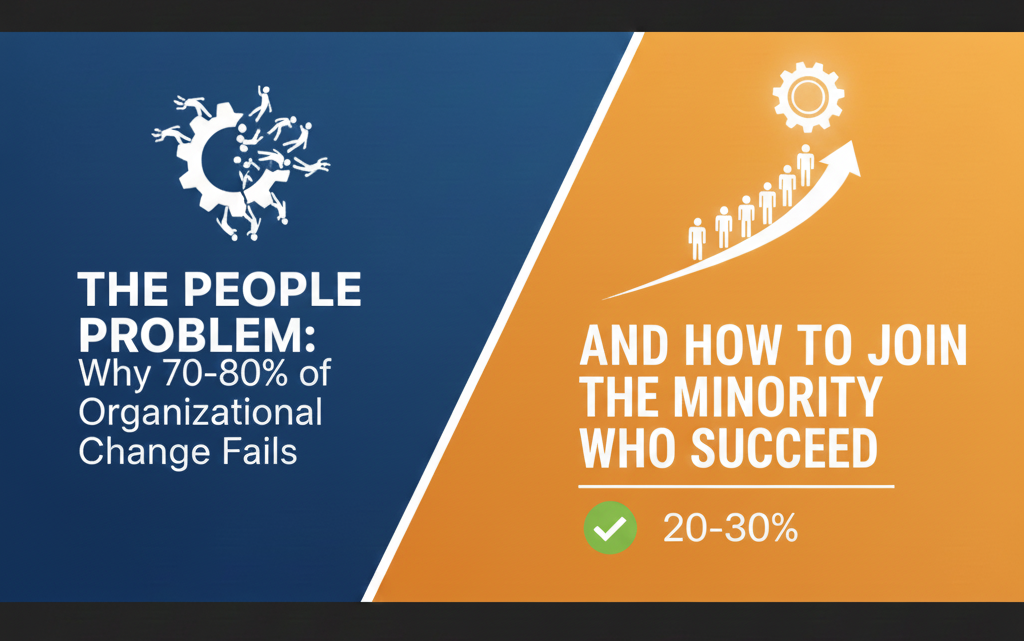
The People Problem: Why 70-80% of Organizational Change Fails (And How to Join the Minority Who Succeed)
1.0 Introduction: The Sobering Statistic
As leaders in higher education, we're conditioned to analyze data. But what do we do when the data shows we consistently fail? A startling 70-80% of all organizational change efforts fall short. This isn't just a number; it's the frustrating reality of pilot programs that never scale, enterprise systems gathering digital dust, and faculty burnout from yet another "initiative of the year."
But what if the reason for this widespread failure isn't the new software, the updated curriculum, or the strategic plan itself? This post will reveal why most change stalls and, more importantly, provide a people-first framework to ensure your next initiative joins the 20-30% that succeed.
2.0 The Fundamental Misunderstanding: It's Not the Technology, It's the People
I’ve built my career on the understanding that the single greatest mistake in leading change is focusing exclusively on the "what" - the new system or process - while completely ignoring the "who." Most initiatives don't fail because of technical glitches; they fail because of human factors. When we overlook issues like resistance from faculty and staff, poor communication, or our own leadership disengagement, we create an environment where even the best ideas are doomed.
Any institutional change is fundamentally a personal change for the people involved. It requires our faculty, staff, and administrators to learn new skills, adopt different behaviors, and shift their mindsets. Ignoring this human element is a recipe for failure.
3.0 The Bedrock of Success: Building on a Foundation of Trust
This brings us to the core of the human element: trust. Before you can ask people to change, you must first create an environment where they feel safe enough to do so.
The Trust-Safety Connection
Trust is pivotal in any organizational dynamic. It fosters psychological safety, which is the essential ingredient that enables smoother change adoption, empowers risk-taking, and encourages collaboration. Without safety, people will not willingly step into the uncertainty that change brings.
The Expert View on Trust
As change management thought leader Edwina Pike explains, the link is direct and inseparable:
“If you’ve got trust, you feel safe. If you feel safe, you’ve got trust.”
The Consequences of Lacking Trust
When people feel their security is threatened, trust erodes and progress comes to a halt. While psychological safety is the goal, it can't exist without foundational safety, including physical and financial security. In academia, where anxieties around departmental reorganizations or adjunct precarity are ever-present, threatening job security, even unintentionally, is the fastest way to make fear inhibit engagement. Understanding this fundamental connection is crucial for any leader guiding an organization through a significant change.
4.0 A People-First Framework for Lasting Change
With a foundation of trust, you can begin to implement a framework that puts people at the center of your strategy. The following principles are not academic theories but lessons I’ve learned in the trenches of institutional change.
Principle 1: Achieve True Strategic Alignment
In my work across multiple college districts, I've learned that a brilliant idea in a silo is a failed initiative waiting to happen. The most powerful tool I've found to combat this is strategic alignment: the active synchronization of goals, resources, processes, and people across the entire institution. It is the only way to turn vision into reality because it eliminates the academic and administrative silos that create friction and kill momentum.
I've navigated this exact challenge many times. Before launching a new Learning Management System (LMS), for example, true strategic alignment requires mapping its impact not just on IT, but on pedagogy, faculty training, and student outcomes. It demands bringing different departments into a collaborative planning process from day one to ensure every part of the institution is working together.
Principle 2: Earn Buy-In as a Process, Not a Mandate
Too many change initiatives are introduced as top-down mandates, which almost always breeds resentment and resistance. Genuine commitment can’t be dictated; it must be earned through a deliberate and inclusive process. Earning this commitment requires a multi-faceted approach, moving beyond simple communication to a focus on behavioral change. Three strategies have been central to my most successful projects:
Empower "stakeholder leaders" who are respected peers capable of modeling new behaviors and championing the change within their teams.
Celebrate short-term successes and quick wins to demonstrate value, build momentum, and reduce resistance.
Involve people in the design process to build ownership. I helped a mid-sized college successfully overcome resistance to a new blended learning model by involving faculty in its design, providing robust training, and establishing a peer mentor program. They didn't just implement a technology; they cultivated a supportive community around it.
5.0 Case Study in Action: Driving CRM Adoption Across a College District
To see how these principles translate from theory to practice, let's examine my work driving CRM adoption at a Community College District, where we applied a people-first approach to a complex technology rollout.
The Challenge
The district needed to centralize student communication and gain visibility into key success milestones, but faced significant hurdles:
Two campuses with distinct cultures and legacy processes.
Wide variation in staff comfort with new technology.
Concerns that the CRM would add workload or become "another system nobody uses."
The People-First Approach
Instead of a top-down rollout, we started by diagnosing the human factors. We conducted interviews and working sessions with counselors, deans, and enrollment teams to understand their workflows and pain points. We identified "change champions" at each college and formed governance groups to co-own decisions. Finally, we built role-based training using real campus scenarios to lower the barrier to use and make the new system immediately relevant to front-line staff.
The Measurable Results
By focusing on people, alignment, and buy-in, we achieved tangible outcomes that demonstrated the change was sticking:
Achieved 75% active user adoption within two terms for key stakeholder groups.
Increased completion of comprehensive student education plans by 42% in one year.
Enabled leadership to monitor near real-time data to support targeted student interventions.
6.0 Conclusion: Leading the Change That Lasts
The data is clear: successful institutional change hinges on a relentless focus on the human side of the equation. These aren't just theories; they are the hard-won principles that have guided my career.
At Cañada College and Skyline College, I learned that change moves at the speed of trust. At the Chabot-Las Positas Community College District, I saw how powerful true strategic alignment could be in unifying disparate campuses around a shared vision. Throughout my work, I've seen that earning genuine buy-in is the only path to lasting transformation. Now, in my consulting work with EtherVine LLC, I apply structured change frameworks to help educational institutions put these people-first strategies into action. By shifting our focus from systems to people, we can lead the kind of change that not only succeeds but lasts.
7.0 Call to Action
What's the biggest change hurdle you're facing in your institution right now? Let me know on Linkedin!